
When asphalt starts cracking, fading, or developing potholes, most property owners ask the same question: Should I patch it, resurface it, or do something else entirely? The wrong choice can waste money, shorten pavement life, and lead to repeated repairs. Unfortunately, many online resources oversimplify the decision-making process or push a single solution without explaining whether it truly fits your situation.
Asphalt patching and resurfacing serve different purposes. Each method solves specific problems, offers different lifespans, and carries its own cost implications. Choosing the best option depends on damage severity, pavement age, foundation condition, and long-term maintenance goals—not guesswork.
This guide breaks down asphalt patching vs resurfacing in clear, practical terms so you can make an informed decision that protects both your pavement and your budget.
Understanding Asphalt Damage Before Choosing a Repair
Before comparing repair options, it’s important to understand why asphalt fails. Asphalt surfaces deteriorate due to:
- Water penetration into cracks
- Freeze-thaw cycles
- Heavy traffic loads
- Oxidation from sun exposure
- Poor drainage or base instability
Surface damage doesn’t always mean structural failure. In many cases, the base layer remains solid while the top layer deteriorates. That distinction is critical when choosing between patching and resurfacing.
What Is Asphalt Patching?
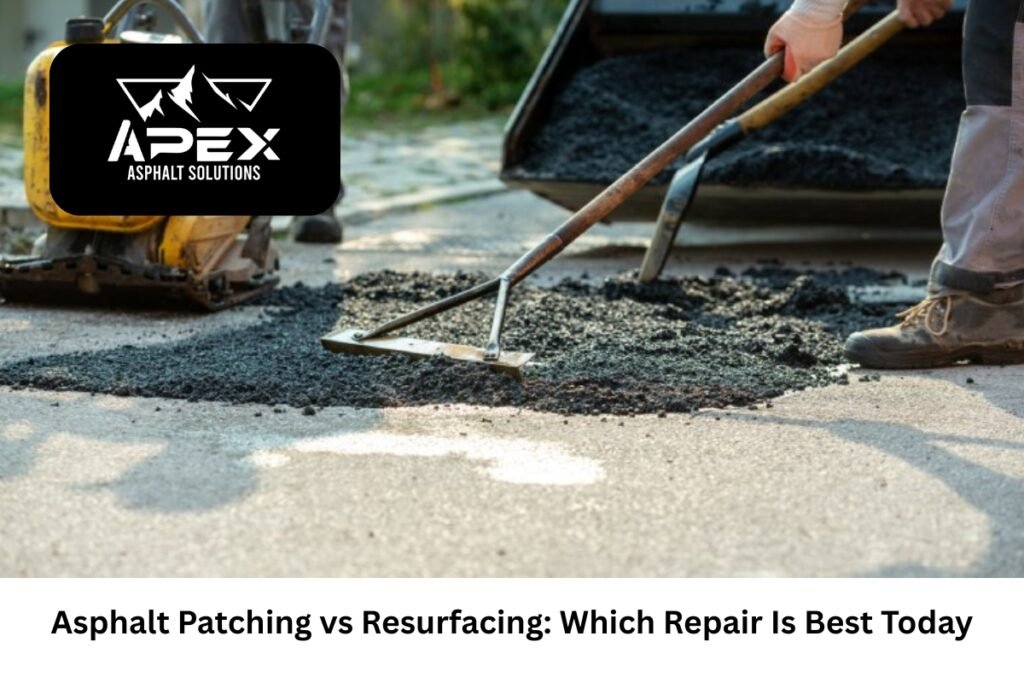
Asphalt patching is a localized repair method used to fix small, isolated areas of damage, such as potholes, depressions, or severely cracked spots.
How Asphalt Patching Works
The damaged area is:
- Cut or cleaned
- Filled with hot or cold asphalt mix
- Compacted to restore the surface level
Patching focuses on specific problem areas rather than the entire pavement surface.
When Asphalt Patching Makes Sense
Asphalt patching is ideal when:
- Damage is limited to small areas
- Potholes are isolated
- Cracks are localized and not widespread.
- The surrounding asphalt remains structurally sound.
Benefits of Asphalt Patching
- Lowest upfront cost
- Quick application
- Minimal disruption to traffic
- Effective short-term solution
Limitations of Asphalt Patching
- Shorter lifespan (typically 2–5 years)
- Visual inconsistency
- Not effective for widespread deterioration
- Repeated patching can weaken overall pavement integrity.
Patching is best used as a targeted fix, not a long-term solution, for aging asphalt.
What Is Asphalt Resurfacing?
Asphalt resurfacing—also called an overlay—involves applying a new layer of asphalt over the existing surface after proper preparation.
How Asphalt Resurfacing Works
The process typically includes:
- Cleaning and preparing the surface
- Repairing existing cracks and minor failures
- Applying a new asphalt layer (usually 1.5–2 inches thick)
- Compacting and smoothing for a uniform finish
Resurfacing restores both the appearance and the functionality of the entire pavement.
When Asphalt Resurfacing Is the Better Choice
Resurfacing is recommended when:
- Damage covers a large portion of the surface
- Cracking is widespread but shallow.
- The base layer is still stable.
- Pavement shows aging, oxidation, or fading.
Benefits of Asphalt Resurfacing
- Extends pavement life by 5–10 years
- Provides a smooth, uniform appearance
- Improves drainage and traffic flow
- Costs significantly less than a full replacement
Limitations of Asphalt Resurfacing
- Not suitable if the base has failed
- Higher upfront cost than patching
- Requires more preparation time
Resurfacing offers the best balance between cost and longevity for many commercial and residential properties.
Asphalt Patching vs Resurfacing: Side-by-Side Comparison
| Factor | Asphalt Patching | Asphalt Resurfacing |
| Best for | Isolated damage | Widespread surface wear |
| Coverage | Small areas | Entire surface |
| Cost | Lowest | Moderate |
| Lifespan Added | 2–5 years | 5–10 years |
| Appearance | Uneven | Smooth and uniform |
| Structural Improvement | Minimal | Moderate |
| Long-Term Value | Limited | High |
This comparison highlights why patching and resurfacing are not interchangeable solutions.
How to Decide Which Asphalt Repair Is Best
1. Evaluate Damage Severity
- Minor, localized damage → Patching
- Widespread cracking or surface deterioration → Resurfacing
If more than 25–30% of the surface is damaged, resurfacing is usually more cost-effective than repeated patching.
2. Assess the Foundation Condition
- Stable base → Resurfacing can work
- Base failure (sinking, severe alligator cracking) → Replacement may be necessary.
Resurfacing over a failed base can cause cracks to propagate through the new layer.
3. Consider the Age of the Asphalt
- Newer pavement with isolated issues → Patching
- Mid-life pavement (10–20 years) → Resurfacing
- Very old pavement with repeated failures → Replacement
Age helps predict how much value each repair will deliver.
4. Think About Long-Term Costs, Not Just Today’s Price
Patching may seem cheaper upfront, but repeated patches often cost more over time than one resurfacing project that lasts years longer.
Signs Asphalt Patching Is the Right Solution
- Small potholes
- Isolated cracking
- Localized surface depressions
- Damage caused by one-time events (utility cuts, heavy loads)
In these cases, patching restores safety quickly without unnecessary expense.
Signs Asphalt Resurfacing Is the Better Investment
- Cracking spread across large areas
- Fading, oxidation, and surface raveling
- Uneven texture without base failure
- Multiple old patches create an uneven surface
Resurfacing corrects surface-level problems while improving overall appearance and performance.
When Neither Patching nor Resurfacing Is Enough
There are times when patching or resurfacing is simply delaying the inevitable. Full replacement becomes the best option when:
- The base layer has failed
- Severe alligator cracking dominates the surface.
- Drainage problems undermine pavement stability.
A professional evaluation prevents wasted investment in temporary fixes.
What Happens If You Choose the Wrong Repair?
Choosing the wrong asphalt repair method can:
- Shorten pavement lifespan
- Increase long-term maintenance costs.
- Create recurring safety hazards.
- Results in visible patchwork and poor curb appeal. l
The biggest mistake competitors make is presenting repairs as interchangeable. They are not.
Maintenance After Patching or Resurfacing
Regardless of the repair method, maintenance determines longevity.
Recommended Maintenance Steps
- Routine crack filling
- Sealcoating every 2–3 years
- Regular inspections for early damage
Maintenance protects your investment and prevents premature deterioration.
Why Professional Assessment Matters
Online guides can educate, but they can’t replace on-site evaluation. Professionals assess:
- Surface condition
- Base stability
- Drainage effectiveness
- Traffic load impact
This ensures the repair strategy matches real conditions—not assumptions.
Final Verdict: Which Asphalt Repair Is Best Today?
There is no one-size-fits-all answer.
- Choose asphalt patching for small, isolated damage when the rest of the pavement is in good condition.
- Choose asphalt resurfacing when surface damage is widespread, but the foundation remains solid.
- Consider replacement only when structural failure is present.
The best repair is the one that delivers the greatest long-term value, not just the lowest initial price.
FAQs
Ans: Asphalt patching repairs small, localized damage, while resurfacing applies a new asphalt layer over the entire surface to address widespread wear.
Ans: Most patches last between 2 and 5 years, depending on traffic and weather conditions.
Ans: Resurfacing typically extends pavement life by 5 to 10 years when the base is stable.
Ans: Yes. Resurfacing costs significantly less than replacement while delivering strong long-term value.
Ans: Yes, if patches are properly installed and the base is stable, resurfacing can unify the surface.
Ans: Replacement is necessary when the base has failed or when structural damage is widespread.